
Help Your Middle Schooler Think Before Asking AI

A practical guide for parents, caregivers and educators who want children to think independently, solve problems and make better decisions about when — and when not — to use AI.

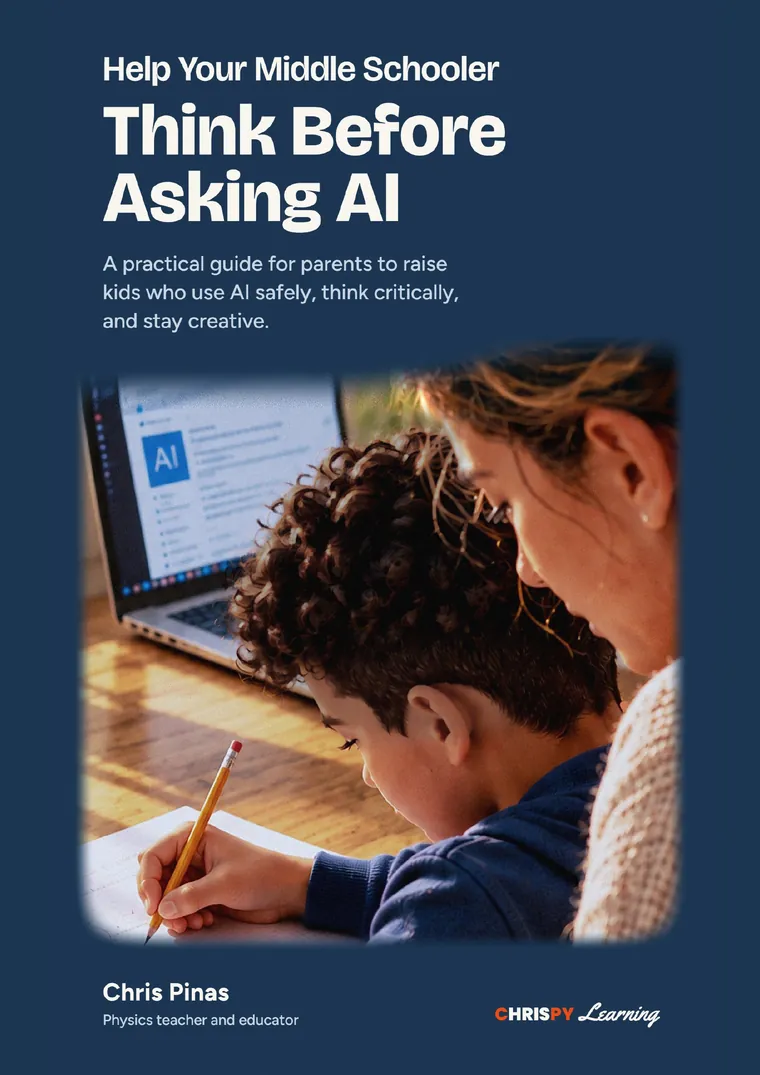
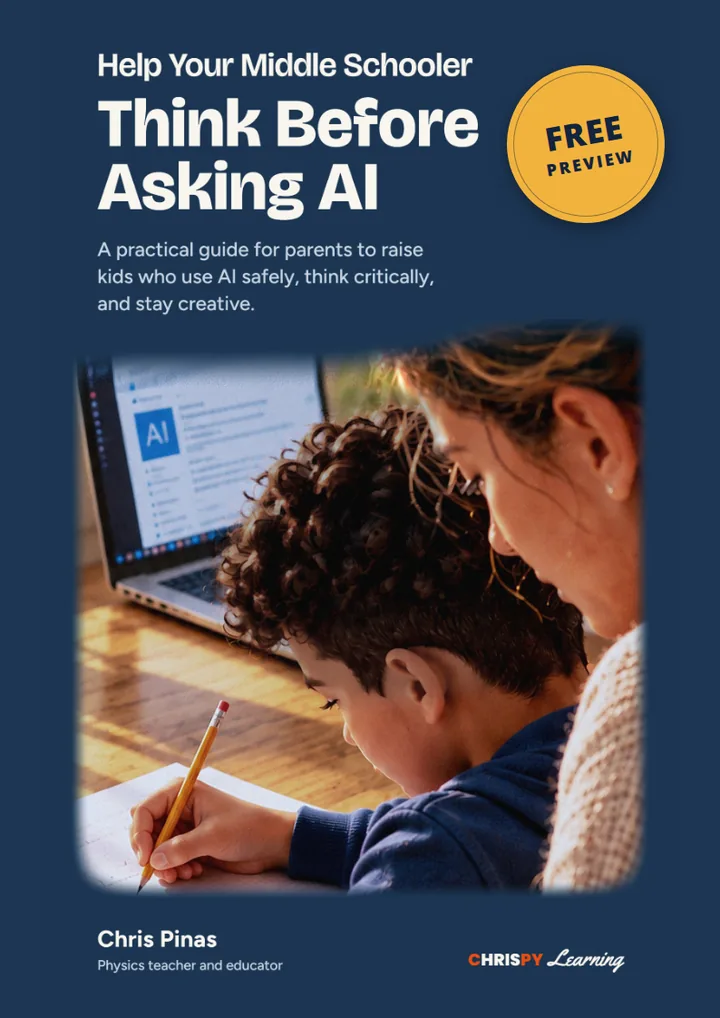
Cover of Help Your Middle Schooler Think Before Asking AI by Chris Pinas: a parent sits beside a child who is writing in a notebook, with a laptop in the background
  • Think
  • Learn
  • Solve
  • Create

When getting an answer becomes easier than thinking.

AI and other digital tools make answers, explanations and ideas easier to reach than ever before. Used well, that can be genuinely helpful.

But the concern isn’t simply whether a child uses AI.

The deeper question is:What happens to a child’s thinking when a technological shortcut is always available?

A familiar homework moment

Your child gets stuck on a homework assignment. A ready-made answer is then just a tap away, often before your child has worked out what the assignment is asking, or what they think.

  • Ask “Do you understand that?” and the conversation can start to feel like a test.
  • Explain the assignment yourself, and you may end up doing the thinking.
  • Say nothing, and a quick response may pass for an answer without anyone checking it.

None of this means technology is the problem, or that children who use it are lazy. It means a child’s own thinking is worth protecting, and worth practicing.

The goal is intellectual independence.

Your child doesn’t need to avoid technology. And your child doesn’t need to depend on it either.

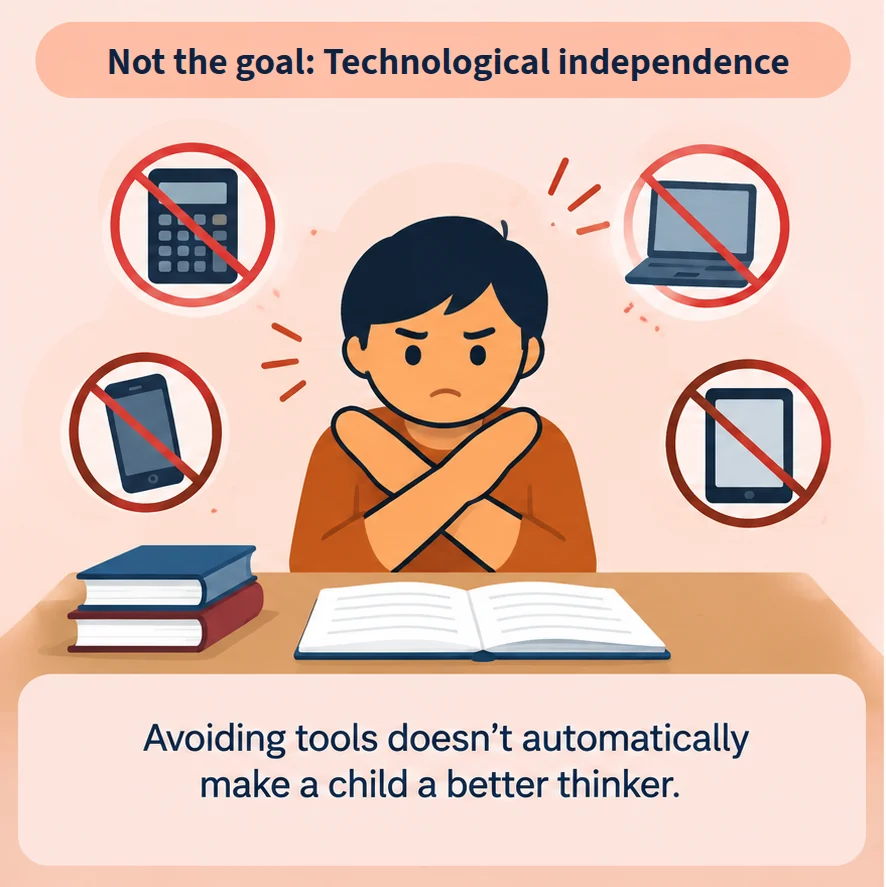
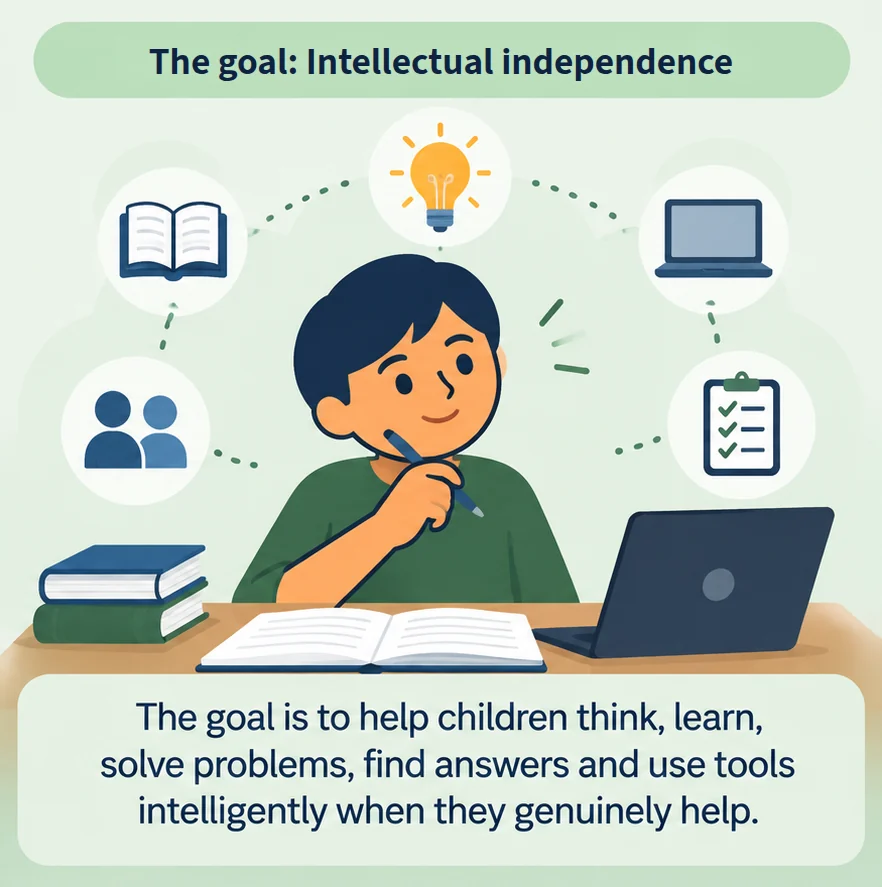
The goal is not technological independence, as if a child should never use a calculator, the internet or AI. The goal is intellectual independence: the ability to think, learn, solve problems, find answers and create, while knowing when a tool genuinely helps and when it doesn’t.

Not this
A child who needs a tool because they no longer know how to start on their own.
But this
A child who chooses a tool because they know it’s useful for this task.

The philosophy of the guide

We are not raising children who know how to get answers from AI. We are helping raise children who know how to think, learn, solve problems and find answers — and who can use AI intelligently when it genuinely helps them.

Chris PinasHelp Your Middle Schooler Think Before Asking AI

AI isn’t always the answer.

AI can be useful.

But not every question needs AI, and not every difficult assignment needs another technological tool.

The important skill is learning to recognize when independent thinking, existing resources, another person, or a tool may be the better choice.

More than an AI safety guide.

There are many resources available about AI safety, privacy, screen time and family rules. They can be valuable, and this guide includes relevant safety considerations too. But this guide’s focus goes much deeper.

Topics you’ll find in many resources

  • AI safety
  • Privacy
  • Screen time
  • Family AI rules
  • Responsible AI use
  • Family AI agreements

This guide takes a different approach.

Its central questionCan a child continue to think independently when powerful tools are always available?

What the guide focuses on

  • Independent thinking
  • Practical observation
  • Real homework situations
  • Applying strategies
  • Practicing new habits
  • Reflection
  • Gradual development of independence

It isn’t simply about creating rules. It helps parents and educators observe what actually happens, practice strategies during real learning situations, and adjust based on what they observe.
Help your child become a more independent learner.

The guide is designed to support a gradual change in how your child approaches difficult work.

  • Stronger independent thinking
  • More confidence when facing difficult work
  • Better problem-solving habits
  • Less dependence on instant answers
  • Better judgment about when help is actually needed
  • More awareness of whether information makes sense
  • Understanding and explaining, rather than simply copying
  • Keeping their own ideas and creativity
  • The ability to create, both offline and digitally
  • Healthier, more intentional use of technology

From consumers to creators.

Encourage children to create with their own minds and abilities, both offline and digitally, instead of becoming dependent on technology for every idea.

Protecting a child’s own thinking also protects the place where their own ideas begin.

Think First

Think First is a practical approach that puts a child’s own thinking at the center of learning.

Instead of automatically reaching for a tool when something becomes difficult, children are encouraged to develop the habit of thinking about what they already know, what they actually need, and what kind of help — if any — would be useful.

Discover the approach inside the guide

From advice to practice.

The guide doesn’t stop at ideas. It helps you work with what actually happens at home or in class, one learning moment at a time.

  1. Observe

    Understand what is actually happening during homework or learning.

  2. Practice

    Apply practical strategies during real assignments and learning moments.

  3. Reflect

    Notice what worked, what didn’t, and what could be adjusted.

A 14-day plan helps you get started, using real homework rather than adding extra homework.

A practical toolkit you can print and use.

Eight resources help your family move from reading about the ideas to applying them during real homework.

For you

  • Your 14-Day Plan

    A day-by-day roadmap from your first observation to a short family check-in.

  • Homework Moment Review

    A short reflection sheet for looking closely at one real assignment.

  • Three-Assignment Tracker

    A simple record of three real assignments to prepare your family check-in.

For you and your child together

  • Family AI Agreement

    A one-page agreement you fill in together about help, privacy and expectations.

  • Think First Homework Flow Card

    A card to keep beside your child during homework, so you can point to the next step instead of repeating an explanation.

For your child

  • Step-by-Step Guide

    A child-friendly guide for working through a problem in a clear order.

  • AI Guidelines

    Simple guidelines that help your child use AI as a coach, not as an answering machine.

  • Example Prompts

    Ready-made questions that ask AI for help, not for answers.

See the editions

Who is this guide for?

  • Parents & Caregivers

    For adults supporting middle schoolers with homework, learning, technology and growing independence.

  • Teachers

    Especially educators working with learners in the middle-school age range who are navigating independent learning alongside increasingly available AI tools.

  • Homeschooling Families

    For parents and caregivers who guide much of their child’s learning and want practical ways to develop independent thinking and responsible technology habits.

Especially useful for adults supporting learners roughly ages 11–14.

Get a Free Preview

Discover the thinking behind the Think First approach.

Read a free preview before you choose an edition. It goes a little deeper than this page, so you can see whether the guide fits your family or classroom.

In the preview

  • Why AI isn’t always the answer
  • The idea behind Think First
  • The central philosophy of the guide
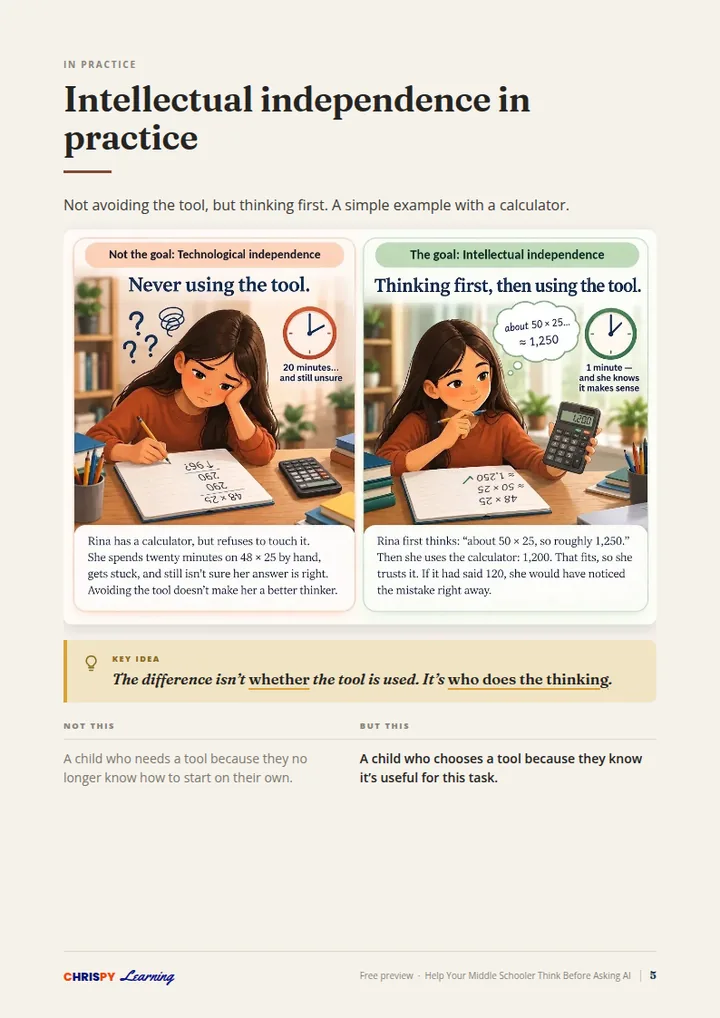
A page from the free preview: “Intellectual independence in practice”, with the illustration of Rina and the calculatorCover of the free preview, with a “Free preview” sticker

Choose your edition.

Every edition is a digital download. Checkout and delivery are handled by Whop.

Available now

  • Think First Printable Toolkit

    The practical toolkit only, as a printable PDF.

    Price: $9.99

    This product includes the practical toolkit only. It does not include the full 44-page guide.

    Includes the 8 toolkit resources:

    • Your 14-Day Plan
    • Homework Moment Review
    • Family AI Agreement
    • Think First Homework Flow Card
    • Three-Assignment Tracker
    • Step-by-Step Guide
    • AI Guidelines
    • Example Prompts
  • Think First Printable Edition

    The complete guide as a printable PDF.

    Price: $14.99

    Includes

    • Complete 44-page printable PDF guide
    • The 8 practical toolkit resources, inside the guide

You’ll complete your purchase on Whop. No payment details are entered on this website.

All editions are currently available in English. Would you like the guide in another language? Let us know

Coming soon

These formats are planned and can’t be purchased yet. If one of them is the format you’d use, tell us.

  • Think First EPUB Bundle

    Coming soon

    The guide as an EPUB, plus both PDF versions.

    Planned price $26.99

    • EPUB
    • Printable PDF
    • Interactive PDF
  • Think First Ultimate Family Edition

    Coming soon

    Every format in one edition.

    Planned price $34.99

    • Interactive EPUB
    • Standard EPUB
    • Printable PDF
    • Interactive PDF
    • Includes future digital updates to the guide and toolkit.

Compare the editions

Swipe sideways to see every edition.

What each edition includes
EditionToolkitPrintableInteractive PDFEPUB BundleComing soonUltimate Family EditionComing soon
Price$9.99$14.99$24.99$26.99$34.99
AvailabilityAvailable nowAvailable nowAvailable nowComing soonComing soon
Complete 44-page guideNot includedIncludedIncludedIncludedIncluded
8 practical toolkit resourcesIncludedIncludedIncludedIncludedIncluded
Printable PDFToolkit pages onlyIncludedIncludedIncludedIncluded
Interactive PDFNot includedNot includedIncludedIncludedIncluded
EPUBNot includedNot includedNot includedIncludedIncluded
Interactive EPUBNot includedNot includedNot includedNot includedIncluded
Future digital updatesNot includedNot includedNot includedNot includedIncluded

Want a better picture and overview of what you’re getting? Download the free sample now 👇🏽

Download the free sample
Portrait of Chris Pinas

About the author

Chris Pinas

Physics teacher and educator.

Chris Pinas is a physics teacher and educator who created this guide to help adults support children in developing independent thinking and responsible technology habits.

Questions and answers

Is this a book about teaching children to use AI?

Not primarily.

The guide focuses on helping children develop independent thinking and better learning decisions in a world where AI and other digital tools are readily available.

Does the guide say children should never use AI?

No.

The guide recognizes that AI can sometimes be useful, but it also emphasizes that AI is not always necessary.

What makes this different from a Family AI Agreement?

A Family AI Agreement can help establish rules.

This guide goes further by focusing on independent thinking, practical observation, practice and reflection during real learning situations.

Is the guide about AI safety?

AI safety, privacy and responsible use are included, but they are not the entire focus.

The broader goal is intellectual independence.

Who is the guide for?

Parents, caregivers, teachers and homeschooling families, especially those supporting learners around ages 11–14.

What formats are available?

Available now:

  • Think First Printable Toolkit
  • Think First Printable Edition
  • Think First Interactive PDF Edition

Planned, and not yet available:

  • Think First EPUB Bundle
  • Think First Ultimate Family Edition
Does the product include the full book?

Think First Printable Toolkit: No. It includes the eight practical toolkit resources only.

Think First Printable Edition: Yes. It includes the complete printable guide.

Think First Interactive PDF Edition: Yes. It includes the complete printable guide plus the interactive PDF.

How does checkout work?

Purchases are completed on Whop, which handles payment and delivers your digital files.

No payment information is collected on this website.

Is the guide available in other languages?

The guide is currently available in English. You can tell us which language you’d like to see next in the feedback section below.